Killer sudoku cage combinations: the complete cheat sheet
When a cage sum and the number of cells lock the contents to a single set of digits, you've found a forced combination. Here's the full table — every cage size, every sum, every digit set you'll ever need.
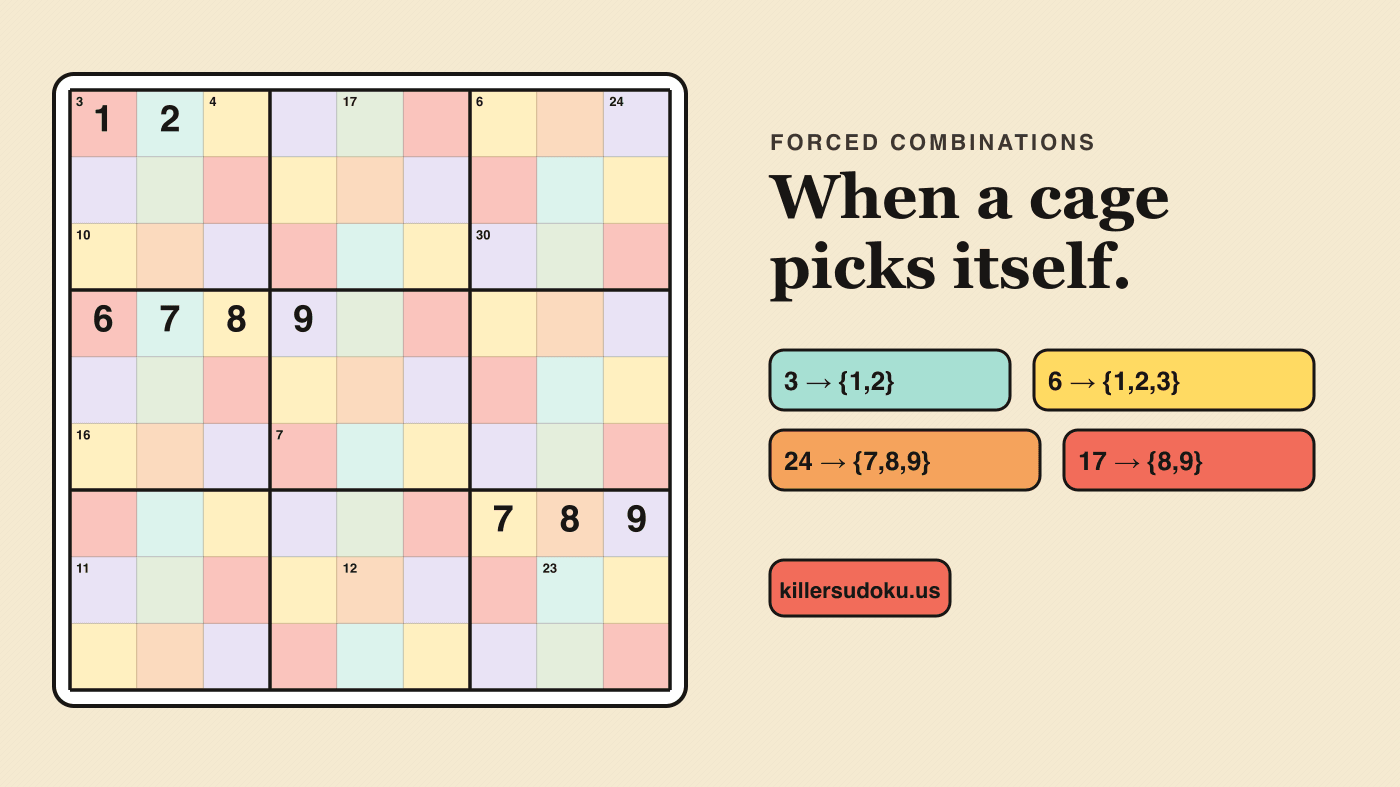
A cage combination is a set of digits 1–9 that add to a given sum. In killer sudoku, when the sum + cell count force a unique combination, those digits have to fill the cage — only the placement is left to figure out.
Memorize the small forced combinations and you’ll spot them at a glance. This article gives you the practical cheat sheet — not every possible combination, just the ones that actually constrain the puzzle.
How to read the table
Every cage in killer sudoku is defined by two numbers: how many cells, and what they sum to. Within a cage, digits cannot repeat (just like in any row/column/box). That repeats-forbidden rule is what makes some sums uniquely solvable.
A 2-cell cage summing to 3 must be {1, 2} — there’s no other pair of distinct digits 1–9 that adds to 3. That’s a “forced” combination.
Forced combinations exist at the extremes: very low sums (you’re forced into small digits) and very high sums (you’re forced into large digits). Sums in the middle have lots of valid combinations.
2-cell cages — fully forced at four sums
| Sum | Must be |
|---|---|
| 3 | {1, 2} |
| 4 | {1, 3} |
| 16 | {7, 9} |
| 17 | {8, 9} |
That’s it. Every other 2-cell sum (5–15) has two or more valid combinations and isn’t forced on its own.
3-cell cages — forced at six sums
| Sum | Must be |
|---|---|
| 6 | {1, 2, 3} |
| 7 | {1, 2, 4} |
| 8 | {1, 2, 5} |
| 9 | {1, 2, 6} or {1, 3, 5} (not forced — listed for completeness) |
| 23 | {6, 8, 9} |
| 24 | {7, 8, 9} |
The two extreme ones — 6 = {1, 2, 3} and 24 = {7, 8, 9} — are gold. They drop three specific digits into three specific cells. Once you know which digits live in the cage, all your peers (the rows, columns, and boxes overlapping that cage) lose those digits as candidates.
4-cell cages — the most useful forced sums
| Sum | Must be |
|---|---|
| 10 | {1, 2, 3, 4} |
| 11 | {1, 2, 3, 5} |
| 12 | {1, 2, 3, 6} or {1, 2, 4, 5} |
| 28 | {1, 4, 9, …} → not forced |
| 29 | {2, 5, 8, …} → not forced |
| 30 | {6, 7, 8, 9} |
The two endpoints — 10 = {1,2,3,4} and 30 = {6,7,8,9} — are the high-value ones. Spot a 4-cell cage worth 30 and you’ve placed 6, 7, 8, and 9 somewhere in those four cells. That can constrain the rest of the board immediately.
5-cell cages
| Sum | Must be |
|---|---|
| 15 | {1, 2, 3, 4, 5} |
| 35 | {5, 6, 7, 8, 9} |
Two cells short of a full row. The forced versions show up rarely but when they do, half the digits for that row/column/box are locked in.
6, 7, 8, 9-cell cages
When a cage covers 6+ cells, it’s nearly a full unit. The 45 rule does most of the heavy lifting:
- A 6-cell cage sums to between 21 (1+2+3+4+5+6) and 39 (4+5+6+7+8+9). Both extremes force the digit set.
- A 7-cell cage sums between 28 and 42. Extremes force the set.
- A 9-cell cage is a full row/column with sum 45 — it tells you only that the 1–9 are inside (which you already knew).
The practical rule: any cage covering ≥ 5 cells with a sum at either extreme of its possible range is fully forced.
The eight combinations worth memorizing
If you want to walk into a hard killer puzzle and recognize forced cages on sight, learn these eight:
- 2 cells = 3 → {1, 2}
- 2 cells = 4 → {1, 3}
- 2 cells = 16 → {7, 9}
- 2 cells = 17 → {8, 9}
- 3 cells = 6 → {1, 2, 3}
- 3 cells = 24 → {7, 8, 9}
- 4 cells = 10 → {1, 2, 3, 4}
- 4 cells = 30 → {6, 7, 8, 9}
You’ll see them constantly. They unlock the puzzle.
The drill
Open any killer puzzle in Killer Sudoku and scan only for the eight combinations above. Don’t worry about anything else for the first pass.
For each one you find:
- Write the forced digit set as pencil marks in every cell of the cage.
- Scan the row, column, and box that those cells live in — eliminate the forced digits from any other cells they share a unit with.
- Watch what falls out: very often a row or column now has a digit that can only go in one remaining cell.
This is the first chain reaction in killer sudoku. Once you’re spotting it without thinking, you’ve graduated from beginner to intermediate.
Beyond forced combinations
Not every cage is forced — most aren’t. The mid-range sums (2-cell = 10, 3-cell = 12, 4-cell = 20) have many valid combinations. For those, you combine cage knowledge with the 45 rule and classic naked pair / hidden pair techniques to narrow them down.
But start with the cheat sheet. It does more work than any other single piece of knowledge in the game.
Try what you just learned