The 45 rule: the first killer sudoku technique to learn
Every row, column, and 3×3 box of a sudoku adds up to 45. That single fact unlocks half the deductions you'll ever make in killer sudoku. Here's how to use it.
If you remember nothing else from a killer sudoku tutorial, remember this:
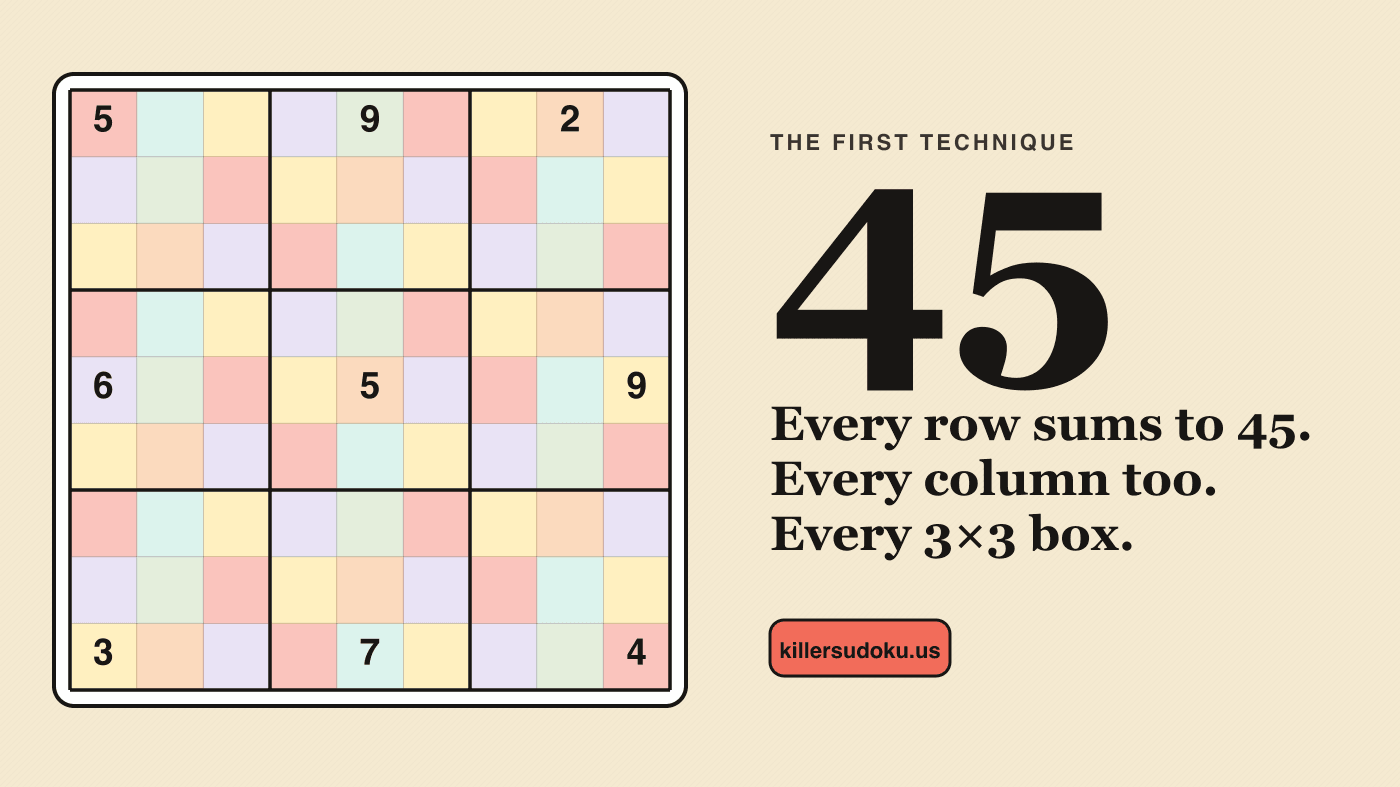
Every row, every column, and every 3×3 box adds up to 45.
That’s just 1 + 2 + 3 + 4 + 5 + 6 + 7 + 8 + 9. It’s the most basic fact about sudoku — and in killer sudoku, where you can’t see the digits yet, it’s the lever that lets you crack the puzzle open.
Why 45 matters
A normal sudoku gives you starting numbers. Killer sudoku gives you cages — outlined groups of cells with a small sum in the corner. The cages tell you how much the cells inside add up to, but never which digit goes where.
The 45 rule lets you convert cage sums into hard constraints. If you know the cages inside a row, you know what those cages add up to. The rest of that row has to make up the difference to reach 45.
The technique in one example
Imagine the top row of a killer puzzle. The cages overlapping that row are:
- A 2-cell cage worth 11, fully inside the row
- A 3-cell cage worth 16, fully inside the row
- A 4-cell cage worth 22, fully inside the row
11 + 16 + 22 = 49. That can’t be right — the row can only sum to 45. So one of those cages must be partly outside the row. That tells you something concrete: the cells of one of those cages have to extend into row 2 (or wherever the cage spills).
Flip it around: when every cage in a row sits fully inside that row, their sums must add to 45. If they add to less, the row has a single-cell “spill” cage that fills the gap.
If three cages in a row sum to 39 and there’s one cell left over, that cell must be exactly 6. You’ve just solved a cell without ever looking at any other constraint.
Where the 45 rule shines
There are three places where 45 saves real time on a typical killer puzzle:
- Single-cell spills. Any unit (row, column, or box) where every cage is “in or out” cleanly tells you exactly what the missing cell holds. These are gifts — scan for them first.
- Two-cell spills. If two cells in a unit aren’t covered by fully-inside cages, you know their sum even though you don’t yet know which is which. That pair sum often combines with cage-combination knowledge to lock both digits.
- Negative space. If a cage straddles two units (say, a row and a box), use 45 on whichever unit gives you the cleanest count. You might find that the cells of that cage outside the unit add to something specific.
The 45-rule drill
Open any killer puzzle on this site. Don’t write a single digit yet. Just look at the first row.
- Count cages fully inside row 1.
- Sum their values.
- The remaining cells in row 1 add to (45 − that sum). How many cells are left? What’s the spill total?
Do that for every row, every column, and every 3×3 box. You’ll usually find at least one unit with a clean single-cell spill — and that’s your first free solve.
When the 45 rule isn’t enough
The 45 rule gets you the total for a group of cells, but not the individual digits. To split a known sum into individual digits, you need the next technique: cage combinations — the small set of digit-combinations that can produce a given cage sum.
Together, the 45 rule + cage combinations will carry you through every easy and most medium killer puzzles. The harder difficulties bring in classic sudoku techniques like naked pairs and hidden pairs — those still build on top of the 45 rule.
Start there. Master it. The rest is downhill.
Try what you just learned